

August 4, 2026 / Articles
Making Room for Network Capacity in Modern Food Processing
Walk onto a modern food production line and it’s easy to see how much smart manufacturing has changed. AI-powered vision systems inspect fill levels and label placement, checkweighers verify product consistency, sensors monitor everything from flow rate to temperature, and coding equipment records batch and date information. Alongside them, predictive maintenance platforms and real-time production dashboards are helping manufacturers build a far more complete picture of what’s happening across the factory floor.
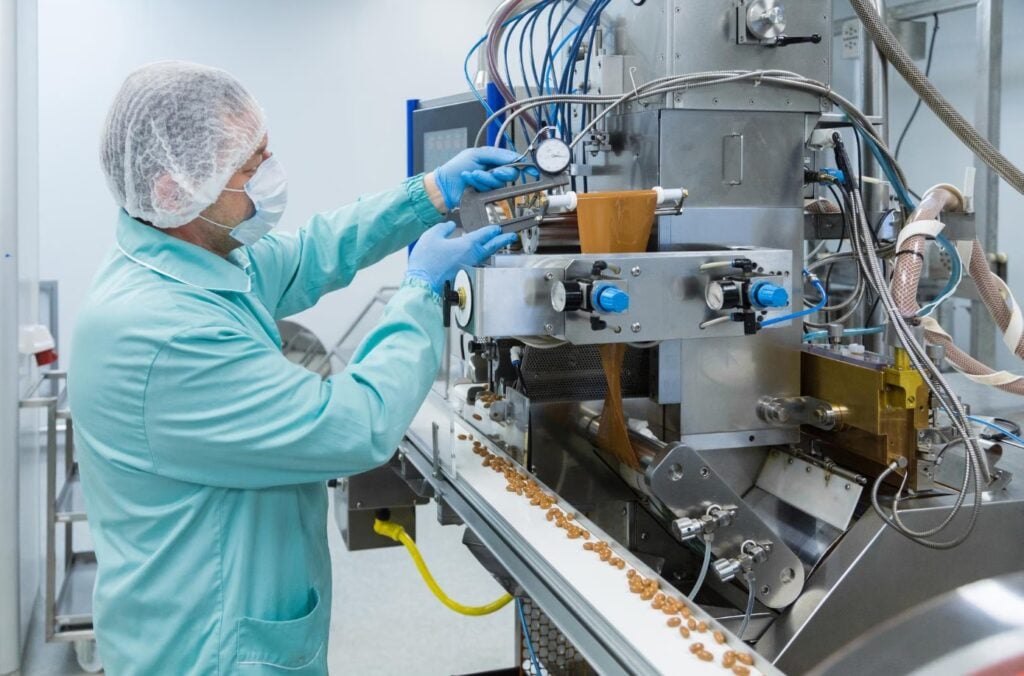
Smart food processing
This transformation is being driven by more than advances in technology alone. Traceability requirements are becoming increasingly demanding, with manufacturers expected to record, retain and retrieve detailed information throughout the production process. In the UK, as well as across the EU, food businesses must operate a “one step back, one step forward” traceability system, meaning they must be able to identify exactly who supplied a particular ingredient or batch, and exactly where the finished product ends up. In the US, the FDA’s Food Traceability Rule requires electronic records of key tracking events for certain foods to be produced within 24 hours of a request.
Whether it’s AI-driven quality inspection, predictive maintenance or digital traceability, these systems all have one thing in common: they rely on a continuous, reliable flow of data from the production line. Every improvement to quality assurance or traceability usually means another device joining the network, while today’s production lines are increasingly expected to generate detailed digital records across more stages of the process.
As more production-critical systems become network dependent, the impact of connectivity issues extends beyond inconvenience. A network interruption can affect production visibility, quality control and ultimately uptime. What often receives less attention is the connectivity infrastructure inside the control panel, yet, as digitalisation continues across industry, it is becoming just as important as the equipment connected to it.
It is a familiar scenario on live production lines: when a network switch runs out of ports, another is added. Then another. Before long, multiple smaller switches can end up daisy-chained together. While this approach solves the immediate problem, over time it can increase wiring complexity, consume valuable cabinet space and introduce more hardware to power, maintain and troubleshoot. Traffic passing between switches is also limited by the single uplink connecting them, which can become a bottleneck as more devices begin sharing data across the network.
In food processing, these challenges are often compounded by strict hygiene requirements and the design principles they drive. Smaller, simpler enclosures mounted close to the production line help minimise surfaces where residue or bacteria can accumulate, but they also leave far less room for networking equipment. The challenge is no longer simply connecting more devices; it is connecting more devices within cabinets that have not grown to accommodate them. Designing for future expansion increasingly means considering not only the sensors and systems required today, but those likely to be added tomorrow. As manufacturers continue to adopt more connected technologies, network capacity and cabinet design need to be considered together from the outset.
Recognising this challenge, Brainboxes will introduce a new solution later this Autumn: a compact 16-port Ethernet switch with top-and-bottom port orientation, developed for applications where panel space is limited. Rather than asking engineers to redesign cabinets around expanding network requirements, it brings greater capacity to the space they already have, reflecting Brainboxes’ approach to industrial connectivity: designing solutions around the realities of modern control panels, not the other way around.